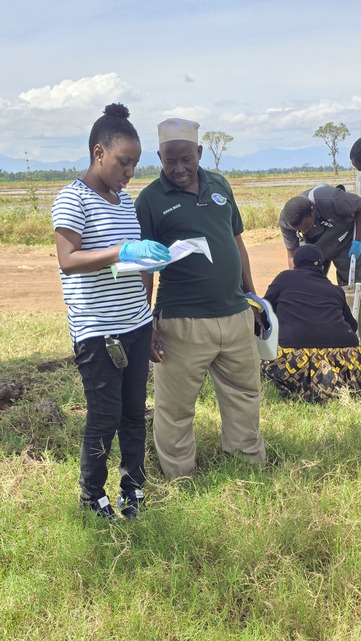
A team led by Dr Grite Mwaijengo Nelson is currently carrying out surveys of water courses and wetland areas in the Lake Babati and Lake Manyara Catchments in northeastern Tanzania. The team, from the Nelson Mandela African Institute of Science & Technology (NM-AIST), is collecting data on some key factors influencing schistosomiasis. This debilitating disease, also called bilharzia and snail fever, is caused by certain species of Schistosoma flukes. The flukes have a complex life cycle, with specific genera of snail acting as an intermediate host.
Dr Nelson and her colleagues are sampling a large number of sites to record ecological variability and snail distribution patterns. They are also engaging with local communities to gain insights into local knowledge, perceptions and practices related to schistosomiasis. We at Live Steams are pleased to support this initial phase of what will hopefully be a larger study. The ultimate goal is to develop and validate an integrated, climate-responsive framework for sustainable schistosomiasis control in northeastern Tanzania . This will be achieved by linking ecohydrological processes, climatic variability, landscape features, and human exposure dynamics within a One Health perspective.